
After the second wave of the pandemic, general and health insurers have seen a fall in their outgo of Covid-related health claims. In the July-September quarter (Q2 of FY22), insurers settled a little over Rs 5,000 crore worth of Covid health claims. This is 35 per cent lower than the Rs 7,700 crore worth of claims they settled in Q1, sources said.

The share of public sector undertakings (PSUs) in the total market capitalisation of listed companies--at an all-time low of 10 per cent currently --- may get a leg-up from the government's divestment push. Recently the government announced the successful sale of national carrier Air India to Tata Sons, India's first privatisation of a PSU since 2002-03. The transaction is expected to be completed by December.

Come October, life insurers may have to tighten their underwriting standards further for retail term plans at the behest of one of the largest reinsurers in the Indian insurance market, Munich Re. According to a source aware of the development, "Munich Re has been studying long-term mortality trends for the past few years, and has suggested some tightening in the underwriting process." "As far as financial underwriting is concerned, the reinsurer has suggested that insurers should ask for additional documents. "For example, apart from income proof, they can ask for bank statements of the prospective customer before issuing policies," added the source.

Affordable pricing, a variety of themes, and the ease of transacting are among key reasons that have made smallcases a hit among young investors.

Twenty years after India's insurance sector was opened up, unshackling the control of state-owned companies, as many as 50 private players have set up shop. Along with their foreign partners, private players have brought about a sea change in the product offering, distribution and underwriting processes, and services levels. Yet, India's insurance penetration needle has not moved much.

Bumper-to-bumper insurance cover for new vehicles will not be mandatory as suggested by the Madras high court in its order last month. Instead, the decision to make it mandatory or not will be left to the legislators and the parliament. On Monday, the court decided to modify its order, which had said that whenever a new vehicle is sold after 1.9.2021, it is mandatory for coverage of bumper-to-bumper insurance every year, in addition to covering the driver, passengers, and owner of the vehicle, for a period of five years.

Since the beginning of 2020, i-bankers have collected nearly Rs 1,800 crore by way of IPO fees. Interestingly, the India fees this year form just 1 per cent of the global fee pool of $13.7 billion from IPOs.

The Securities and Exchange Board of India (Sebi) has introduced an optional T+1 settlement cycle for the markets. T+1 means that settlements will have to be cleared within one day of the actual transactions taking place. The regulator has put the onus on the stock exchanges to decide whether they want to opt for the shorter settlement cycle for any of the listed scrips. This can be done after giving a one-month prior notice to all stakeholders.

If the court order is implemented, it will lead to an increase in the insurance outgo for car owners by a minimum Rs 50,000 for car and a minimum of Rs 7,000 for two-wheeler owners.

'We need people who can position a product digitally and craft the journey for customers, by improving user interface and user experience.'

'It is going to be a tough balance for the RBI to manage economic stability and ensure smooth government borrowing.'

The payments industry is at a crossroads with the banking regulator on two pressing issues, neither of which seems headed towards an amicable solution. Depending upon which side accommodates the other, customers in India will have to choose between convenience and ironclad safety. In the end, the Reserve Bank of India (RBI), which regulates both banks and all payments services providers, will prevail. But the question is: will it do so by bending a little or by sticking to its firm stand? The two issues - one concerning payment facilitators storing customers' card details and the other about auto-renewal of payments - appear similar but aren't.

'Covid-related claims were almost 2.5 times the normal claims size.'

A day after the Reserve Bank of India (RBI) lifted its ban on HDFC Bank on issuing new credit cards, the country's largest private sector lender on Wednesday said it had resources and plans in place to "further reinforce pole position in the credit card segment" and that it would "come back with a bang". "We will aggressively go to the market, with not just our existing suite of credit cards but also new offerings in the form of co-brands and partnerships," Sashidhar Jagdishan, managing director and chief executive officer of HDFC Bank, said in a letter to his employees. The bank's management had earlier indicated that the lender had been sourcing liability customers aggressively over the past few months.
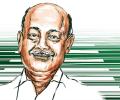
Radhakishan S Damani, investor and promoter of the D-Mart supermarket chain, has broken into the elite club of the top 100 global billionaires. Damani, who grew up in a single-room apartment in Mumbai, is now ranked 98th on the Bloomberg Billionaires Index with $19.2 billion as his net worth. The index is a daily ranking of the world's richest people. The other Indians on the top 100 rich list ahead of Damani are Mukesh Ambani, Gautam Adani, Azim Premji, Shiv Nadar, and Lakshmi Mittal.

In an indication of easing financial stress among borrowers, the number of unsuccessful auto-debit requests through the National Automated Clearing House (NACH) platform declined in July, reversing a three-month trend that started with the second wave of the Covid-19 pandemic. According to the NACH data, of the 86.4-million transactions initiated in July, 33.23 per cent, or 28.7 million transactions, failed, while 57.7 million were successful. Compared to June, this is a significant improvement in bounce rates.

'For HNIs, shifting economic activities outside India by creating regional hubs for businesses is a better option.'

Unified Payments Interface (UPI), the flagship payments platform of the National Payments Corporation of India (NPCI), made a record in volume and value of transactions in July as digital payments rise in the pandemic. UPI processed a record 3.24 billion transactions in July up 15.7 per cent from June when it processed 2.8 billion transactions. In value terms, in July, the platform processed transactions worth Rs 6.06 trillion, up 10.76 per cent from June.

The non-life insurance industry has received over 1 million Covid-related claims in the first quarter of the current fiscal year (Q1FY22), higher than in the entire FY21, indicating the severity of the second wave of the pandemic. According to the General Insurance Council data, which is not publicly available, non-life insurers have received 1.22 million Covid-related claims so far in FY22 and have settled 944,573 of those worth Rs 9,178 crore. In comparison, they had received 986,366 Covid claims in FY21 and settled 849,034.

The Reserve Bank of India's (RBI's) move to ban Mastercard from issuing new cards for not complying with the local data storage guidelines may hit five private banks, a non-bank lender, and a major card-issuing company. The impact is expected to be felt for a few months as these players transition to other card networks. According to Nomura Research, RBL Bank, YES Bank, and Bajaj Finserv are the ones most impacted by the ban as all their credit card schemes are allied to Mastercard. Among others, IndusInd Bank, Axis Bank and ICICI Bank have 35-40 per cent of their credit card schemes tied to Mastercard, the report said.
 © 2026 Rediff.com - Advertise with us - Disclaimer - Privacy Policy - Sitemap - Feedback - About us - Terms of use - Grievances